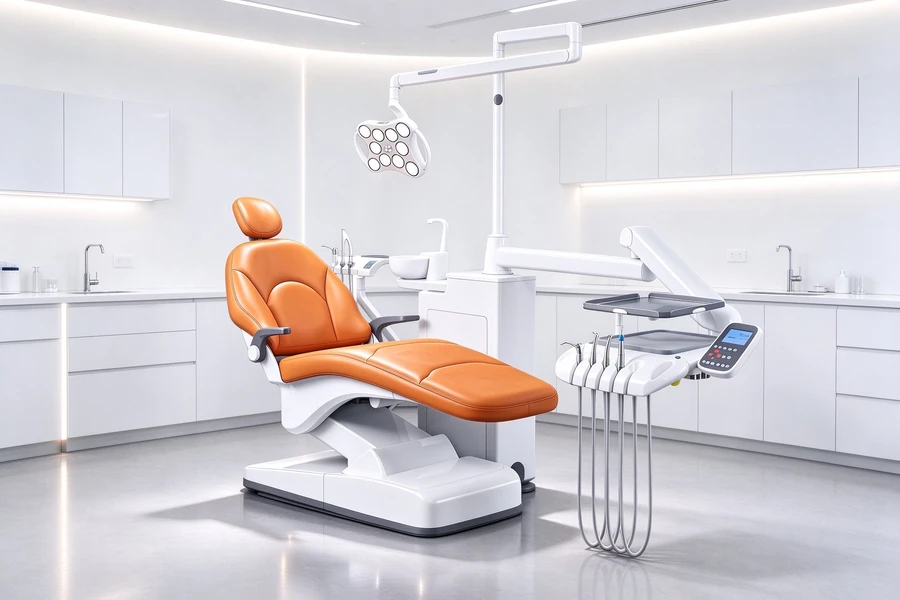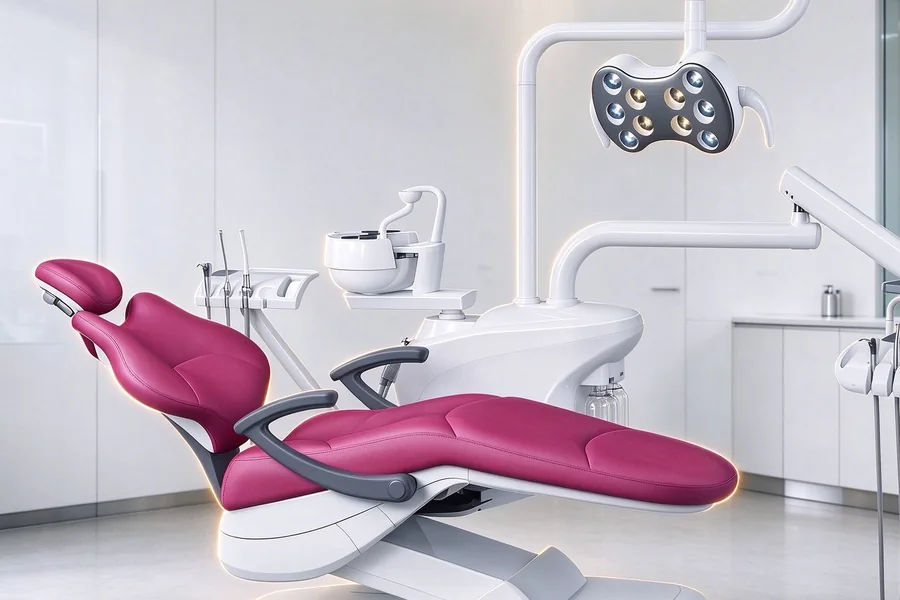
"How much is a dental chair?" is the most asked and most mis-answered question in procurement. The same sentence can mean three very different price tags depending on configuration, certification coverage, and order volume. Start with ranges, then understand what pushes the number up or down.
Every figure below is a reference FOB China (major port) ex-works band, excluding international freight, destination duties, insurance, and installation. Use them to build a budget concept, not as a quotation.
1. Three price tiers by configuration
| Tier | Typical configuration | FOB China reference (USD/unit) | Best for |
|---|---|---|---|
| Basic | Hydraulic or simple electric drive, standard delivery unit, basic LED light, standard upholstery, single clinical chair | 700–1,500 | Budget-sensitive primary care, first distributor order |
| Mid-range | Electric drive, complete delivery unit (3-way syringe, suction, fiber-optic handpiece ports), adjustable-color-temperature LED, memory positions, doctor's stool | 1,500–3,000 | General practice, multi-chair group clinics |
| High-end / implant flagship | Multi-motor联动, large touchscreen, multi-articulated headrest, independent water bottle with anti-retraction, implant/surgical kit, custom upholstery | 3,000–6,000+ | Implant centers, premium private, government/teaching tenders |
The upper bound is not a ceiling. Large touchscreen interaction, imported core components, full-chair customization, or special certification (e.g. SFDA registration support for some Middle East markets) can push a single unit higher.
2. The six factors that actually set the price
1. Drive system. Hydraulic is mature and low-repair-threshold, usually cheaper than high-precision electric. But within "electric," single-motor vs multi-motor linkage and whether memory positions are included create real gaps.
2. Delivery unit completeness. The delivery unit is not just "where tools sit" — it decides four-handed efficiency. Whether negative-pressure suction, 3-way syringe, and fiber-optic handpiece ports are pre-wired, and whether the tray is fully removable for cleaning, matters far more than appearance. Retrofitting later costs far more than factory configuration.
3. Operating light quality. "LED light" spans a wide range: spot diameter, color-temperature range, color rendering index (CRI), and illuminance decay curve each map to cost. A light with CRI above 90 and adjustable spot costs noticeably more than a fixed single-color lamp.
4. Upholstery and surface treatment. The seat-base shell, armrests, and backrest material (cast aluminum vs plastic) decide the three-year collapse risk. This is the part most often cut to the minimum, and the main source of warranty claims.
5. Certification coverage. For the same unit, whether the certificate's model list includes it, whether the notified body is authoritative, and whether the destination market requires extra registration all show up in the price. CE/FDA/ISO documents that can be verified one by one carry a cost of their own.
6. Customization and MOQ. OEM/ODM sampling, tooling, logo silk-screening, upholstery color, and multilingual manuals all dilute or raise unit price by order volume. Single-unit sampling versus full-container ordering differ substantially.
3. Three hidden cost categories not in the sticker price
The price is only the part before the port. What decides three-year total cost also includes:
- Freight and Incoterms. Under FOB, CIF, and DDP your responsibilities and cash outflow differ completely. DDP looks convenient but embeds destination-country fees into the landed price.
- Duties and registration fees. Dental chairs typically fall under HS 9018.49; tariff rates vary by destination, and some markets add mandatory registration fees.
- Spare parts and consumables. Seals, LEDs, suction tubing, foot controls — their unit price and replacement cycle should be budgeted annually before signing.
4. How to choose across the three budgets
- First order / primary care: Basic tier is enough to validate the market, but write "service response" and "spare-part supply term after discontinuation" into the contract to avoid being cornered later.
- General-practice main chair: Mid-range is the value sweet spot — complete configuration, low failure rate, easy to resell or lease.
- Implant / premium positioning: Go straight to high-end or implant flagship; verify multi-articulated headrest, independent water bottle, anti-retraction, and implant kit rather than appearance.
Frequently Asked Questions
Can a dental chair really cost only a few hundred dollars? Yes, but that is usually a minimal configuration, no certification or certification not covering that model, and a full-container large order diluting the unit cost. For a single small batch requiring verifiable certificates, the price is clearly different. The yardstick is not "how low the list price is" but "can it be compared horizontally at the same configuration."
Why do two quotes differ by 3x? Most likely the configuration and certification basis differ, not one supplier gouging. Align the six-dimension parameter table item by item before comparing; the gap usually narrows to within 20%.
Is FOB or CIF better for me? It depends on whether you have a trusted freight forwarder and customs clearance capability. With clearance capability, FOB is more controllable; for a first import unfamiliar with destination logistics, CIF or DDP is easier but raises the landed price.
Does certification affect price? Yes. Equipment whose certificate covers the model, issued by an authoritative notified body, and with destination registration completed, carries compliance cost in the price. Ask the supplier for certificate scans and verify the numbers yourself on the regulator's website — more reliable than a brochure.
What is the typical minimum order quantity? Standard models often start at a few units; customization (OEM/ODM, color, silk-screen) has a higher MOQ and may involve tooling fees. Confirm in writing with the supplier.
Next step
If you are building a budget, send us three pieces of information: clinic type and number of chairs, main business mix (implant/ortho/pediatric/general), and target market with certification requirements. We will return a scenario-based parameter table and corresponding price band, not just a single number.
Gladent (GLADENT) operates its own manufacturing base in Nanhai, Foshan, exports to more than 100 countries and regions, and holds ISO 13485, EU CE (TÜV Rheinland, notified body 0197), and US FDA establishment registration. Every model's certificate number and coverage can be verified one by one on the official certification page.